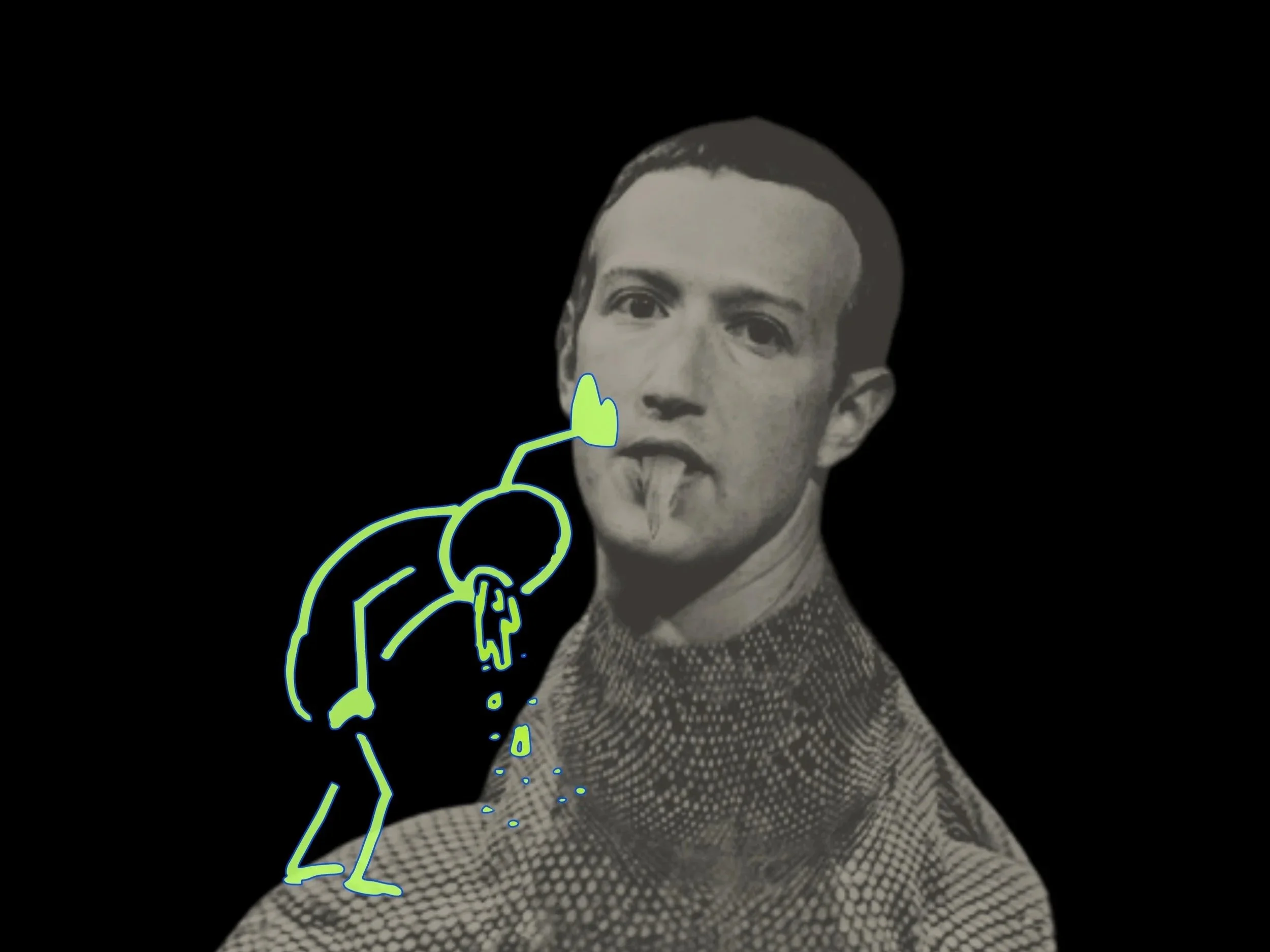
A guide for navigating the online reality
Dear pulp-eater, how far you have come.
We have selected the good pulp for you.
This page is for people who understood The Pigs & The Pulp-Eaters, for people who didn't get any of it, for people who want to know more, for people who follow the herd of sheep, for people who don't even know there is a herd, for millennials, Gen Z, Gen X, for artists and IT nerds, for freelancers and managers.
I have spent the last months researching the effect of social media algorithms on public opinion, society and the individual, followed by a deep dive into big tech and privacy. I have read books, listened to podcasts, saw art and had conversations. And now, at the end of this project - I would like to tell you what I have learned.
No regression, but Progress in a different way
This is a manifesto for regulation and change, not regression. This page is not an incitement to extreme polarization, but a pleading letter to you, the public, my fellow human being, to be critical of everything that holds power over your life. I cannot convince you or myself to throw out your tech devices. But maybe I can try to help us make progress towards a future that is fairer and better for EVERYONE in the long term. I have attempted to explain in this text that change begins with you as an individual, offering small forms of resistance - which ultimately, together with many other individuals, make an impact.
For starters, I would like to ask you something.
When will you get used to the idea of being surveilled all the time?
Or are you already used to it?
We have the possibility of always being seen and to look at others. We are deliberately seeking it out. Willingly being filmed in public, watching other people at breakfast, raising their children, interviewing themselves, having all their personal talents, thoughts, facts and insecurities published online. Under the cover of "for our friends to see and like," to make easy money or under the notion that this is the new way to build connections.
I wonder: when somebody asks you on your 60th birthday what you remember most from all those hours of scrolling, what would you say? Was it worth your time? Did you enjoy it more than seeing your friends and making the jokes yourself? Or getting better at something you love, instead of saving the tutorial you saw on Reels and never looking at it again? What would your future self-wish you had done with your spare time, while you were still able-bodied?
We, the consumers, are not at fault here. We had no choice. This became normal over time, through the company’s design of products that were faster and more beautiful than ever. Through advertisement and cleverly designed public image they could creep into every corner of our society. We had to normalize this oddly shaped reality to survive.However, now that the systems hold so much influence over us, it is our responsibility to draw the line.
The influence of social media on our lives and minds is undeniably a concern.
But after researching the big tech companies behind the social media platforms, what I find to be even more concerning is this:
We - myself included - do not seem to want to acknowledge the fact that:
These new tools are no longer just communication tools, but billion-dollar businesses.
These programs form a new kind of governance.
These people behind the AI’s and media platforms shape the way we wage war.
The tech giant’s success and fortunes are built by leeching off our efforts and profiting on society’s conflicts.
These structures, language bots, apps, data centers, and dining on top of it all: the billionaires,
THEY ARE NOT OUR FRIENDS.
Even though they entertain us so.
A friend is someone who is available and open.
A friend is a source.
A friend is an imperfect companion.
A friend is an addition to your life.
A friend does not try to make money off your body, lip size, teeth, clothing choices, breast size, weight, food, children's brain development, our own brain power, motivation, happiness, political opinion or vote, OF YOUR TIME.
OF YOUR LIFE.
OF OUR LIVES.
A friend is not this.
But we keep hoping for it to gift us the same validation and love, yet we never come back fully satisfied. So why do we, to this day, treat them as though they are our loving daddies? We spare them and turn a blind eye. Why? “Because that is the way the world works these days.” “Because we cannot envision a life without them.” Because we are addicted to their product?
We, the consumers, have the power to choose differently. They have not taken our free will from us yet. So I would encourage you to use that freedom.
Let them know that you - the consumer, the working class, the supposed victims of their scheme - do not agree. That we, as a collective across our country and the world, would not like to continue this way.
Saying no to the system that surrounds us is scary. But you are not alone in this. There are so many people already resisting, and they do so in so many different ways.
They can be as small as deleting an app and your account, or once every two months protesting in the streets.
I can hear you thinking: "What does it matter if I, one individual, do this? How can I make change happen?"
To that I would like to quote: https://www.bnnvara.nl/artikelen/chatgpt-down-waarom-gaan-mensen-weg-bij-openai In 2026, 4 million people boycotted ChatGPT. And it worked. It became mainstream news and the CEO of OpenAI had to answer questions publicly, and now the public opinion about AI is shifting.
This is why I am suggesting some alternatives to Big-Tech.
Because change is possible. A boycott can be a strong symbol. Maybe there is hope, Maybe the effect is not clearly visible after the first act, but after the first conversation you had about your doubts and fears with someone likeminded and opposite to you.
Thank you for your consideration, and FUCK BIG TECH.
Alternatives
Qwant:https://www.qwant.com/?l=nl
DuckDuckGo:https://duckduckgo.com/
Ecosia:https://www.ecosia.org/
MetaGer: https://metager.org/?focus=produkte
Huggingface: https://huggingface.co/
Thaura: https://thaura.ai/
Jan AI:https://www.jan.ai/
Instagram (meta)
Pixelfed:https://pixelfed.org/
WhatsApp (meta)
Signal:https://signal.org/nl/
Element:https://element.io/
Matrix:https://matrix.org/
Threema: https://threema.com/en
YouTube
Search engines
AI
Social media
Services
gmail (google) /outlook (Microsoft)
Proton Mail: https://proton.me/nl/mail
Tuta Mail: https://tuta.com/nl
Mailbox:Mailbox.org
Tresorit:https://tresorit.com/m/email-encryption-service
Google drive / Icloud
Nextcloud:https://nextcloud.com/
Proton Drive:https://proton.me/nl
google foto’s
Ente Photos:https://ente.com/nl/
Immich: https://immich.app/
Google Maps
Organic Maps: https://organicmaps.app/
HERE WeGo:https://wego.here.com/
Komoot:https://www.komoot.com/nl-nl
Word (Microsoft)
LibreOffice Writer: https://nl.libreoffice.org/
CryptPad Docs:https://docs.cryptpad.org/en/index.html
Teams (Microsoft)
Element:https://element.io/
Matrix:https://matrix.org/
Nextcloud Talk: https://nextcloud.com/talk/
Jitsi Meet: https://jitsi.org/jitsi-meet/
PowerPoint (Microsoft)
LibreOffice Impress: https://nl.libreoffice.org/download/
OnlyOffice Presentations: https://www.onlyoffice.com/slides
Excel (Microsoft)
LibreOffice Calc: https://nl.libreoffice.org/download/
OnlyOffice: https://www.onlyoffice.com/sheets?docs=download
Triodos bank: https://www.triodos.nl/
Fairphone:https://www.fairphone.com/nl
Software
Finance
Smartphone
Want to be inspired?
Watch
Hyper normalization: Adam Curtis
https://youtu.be/yS_c2qqA-6Y?is=_IHbyXJu-WZKyxJ8
The social dilemma: https://www.jaronlanier.com/
Signal: Meredith Whittaker
https://tegenlicht.vpro.nl/artikelen/jouw-privacy-als-verdienmodel
-Jaron Lanier: 14:17
Listen
https://www.damnhoney.nl/aflevering-281/
Read
https://www.volkskrant.nl/kijkverder/v/2026/big-tech-europa-vs-alternatieven-overzicht~v2847787/
Susanna Subof- Tech critic
https://shoshanazuboff.com/book/recent-work/
Technofeudalism: What Killed Capitalism- Yanis Varoufakis
https://www.yanisvaroufakis.eu/category/books/technofeudalism-what-killed-capitalism/
Manufacturing Consent: The Political Economy of the Mass Media- Edward S. Herman and Noam Chomsky.
News
Boycot & chatgpt: